
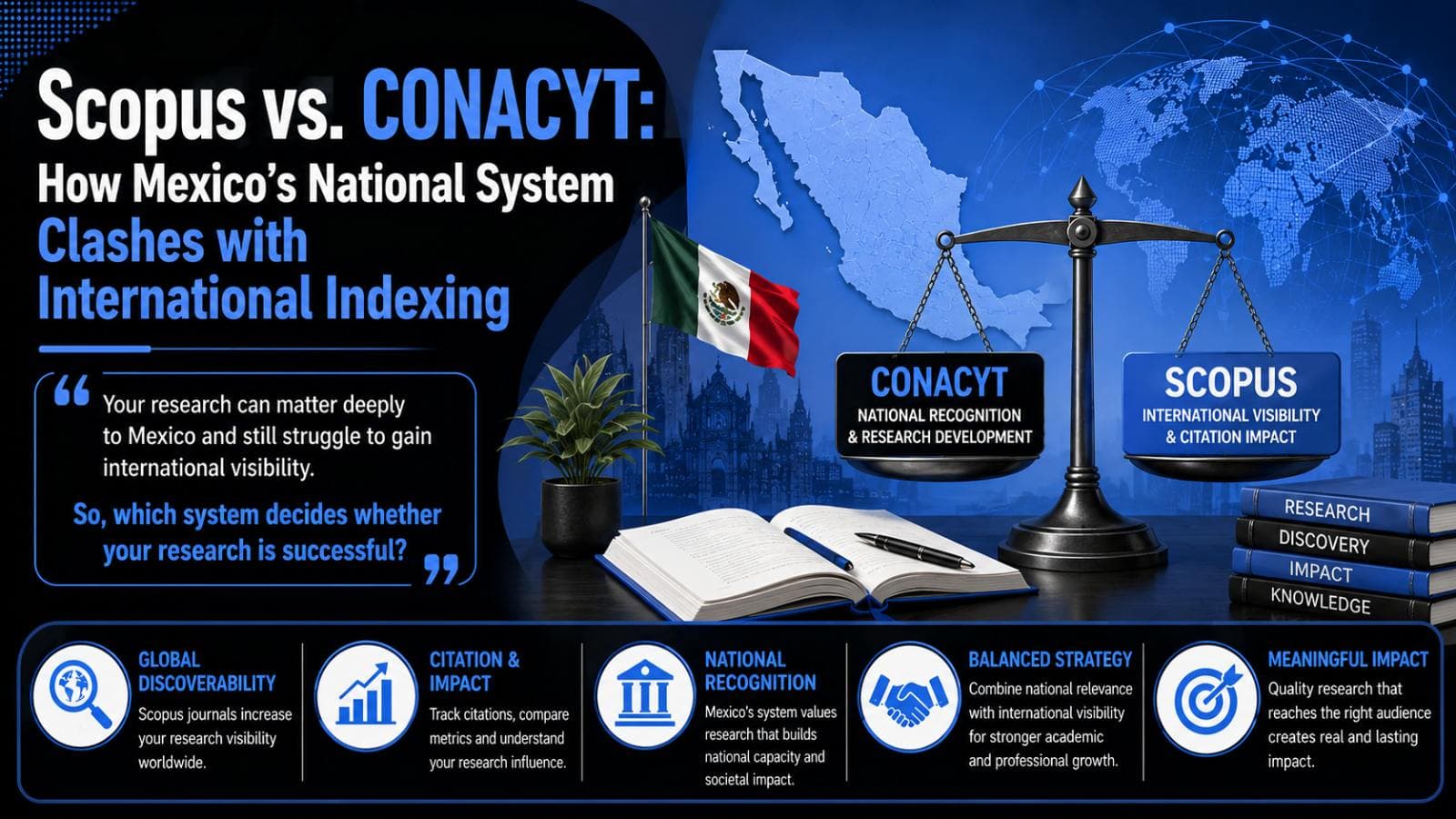
"A paper can be nationally recognized and still struggle to gain international visibility. So, what happens when two systems measure research by very different rules?"
For an author in Mexico, having one's article published goes beyond mere acceptance.
A different question is posed after one has been published:
How is the publication going to be acknowledged?
Apart from this, universities, sponsors, and researchers could use databases such as Scopus that work on an international scale in order to highlight their citations and impact.
This produces a dilemma that could be easily misunderstood.
Scopus and CONACYT are not two competing indexing systems.
Scopus is an international database that provides scientific indexing. The national science system in Mexico, which was traditionally linked to CONACYT/CONAHCYT and is currently under SECIHTI, serves a more general goal: to enhance the country's scientific capacities and acknowledge the contributions of scientists to national development.
The real Scopus vs CONACYT question, then, is not which database is better.
It is:
How can Mexican researchers satisfy national expectations while also building international research visibility?
First, Understand What Scopus Actually Does
Scopus does not evaluate whether a Mexican researcher is a good scientist.
Instead, it indexes scholarly sources and provides tools for discovering research and examining citation performance.
Its content-selection process uses an independent Content Selection and Advisory Board, which reviews titles using qualitative and quantitative criteria.
For researchers, this makes Scopus journals attractive because publication in an indexed journal can place their work within a large international research database.
But "indexed" does not mean "automatically excellent."
Researchers should always ensure they examine the journal's subject area, editorial quality, citation indicators, publication ethics and current indexing status.
What Scopus gives researchers
- International discoverability
- Citation tracking
- Journal-level metrics
- Subject-area comparisons
- Information about journal publishers and sources
- Data that can support research benchmarking
Scopus has indicators based on CiteScore, CiteScore Percentile, and SJR. It is essential that journal indicators be evaluated with regard to their subject matter, since citation behavior varies across different fields.
Then What 'Was' and 'Is' CONACYT's Role?
Here is where the story gets more exciting.
Mexico developed a national research infrastructure for developing scientific capabilities and recognizing researchers.
The historically established system known as CONACYT became CONAHCYT, and, after some institutional changes, SECIHTI currently oversees it.
This development is important when you want to write about the present situation of research in Mexico: calling "CONACYT" could mean either the historically established institution or the system preceding the present one.
It is also true that the SNI will continue playing a critical role in the recognition of researchers.
The objectives under the existing system include strengthening the capacity of the country scientifically, technologically, through the humanities, and innovation, through the recognition of researchers.
Evaluation is also not based on counting papers.
The existing criteria include that the process of evaluation considers the whole activity of a researcher and their trajectory, which includes teaching, academic, and professional activities. It differentiates between qualitative and quantitative criteria.
That difference is crucial.
Scopus vs. Mexico's National Evaluation: Two Different Lenses
Think of a researcher standing in front of two doors.
One door asks:
"How visible and influential is this research within international scholarly communication?"
The other asks:
"What has this researcher contributed to science, society and national development?"
Neither question is identical.
| Area | International Scopus system | Mexican national system |
|---|---|---|
| Main focus | Scholarly sources, discovery and citation information | Researchers, trajectories and national scientific capacity |
| Geographic scope | International | National |
| Main unit | Journals, sources, publications and citations | Individual researchers and their contributions |
| Important evidence | Citation metrics and source information | Quantitative and qualitative academic evidence |
| Research visibility | Strong international emphasis | Broader national-development perspective |
| Evaluation purpose | Discovery, analysis and benchmarking | Recognition and strengthening of research capacity |
| Key risk | Chasing metrics without context | Assuming national recognition equals global visibility |
This is why a researcher should never assume that success in one framework automatically transfers to the other.
Where Does the "Clash" Come From?
This contradiction comes out in practice when researchers get different messages regarding publication and motivation.
Consider a young scientist in Mexico studying an environmental issue relevant to his region.
The national organization may appreciate the research since it tackles a problem in Mexico.
On the other hand, the international journal will want to know:
- What is the broader scientific contribution?
- How does the study connect with international literature?
- Is the methodology reproducible?
- Can researchers outside Mexico apply the findings?
- Is the paper relevant to the journal's international readership?
The research itself has not changed.
The evaluation lens has changed.
One of the most powerful lessons that emerges from the debate on science and policy in Mexico, in this case, is that the disputes on financing, institutional independence, research recognition, and scientific governance cannot be separated from the broader issue of which research is made visible and recognized. It was also made clear that there are some international standards of publication that should be considered in evaluating researchers.
Why International Publication Still Matters
Publishing in Scopus Journals is useful for gaining international recognition for a researcher from Mexico.
They become more easily discoverable through the database, and citations in the journal can be tracked through Scopus.
However, it is important that researchers avoid making a common mistake:
Scopus is no shortcut to quality research.
Even a bad paper published in a top-ranked journal is still bad research.
Similarly, an important study that gets published in a lower-ranked international publication may still be very socially or nationally important.
What constitutes the best strategy for publishing:
Research quality + appropriate journal + ethical publishing + national relevance + international visibility
That is much more meaningful than simply chasing a ranking.
Don't Confuse Indexing With Ranking
Another common mistake is treating Scopus journal ranking as the same thing.
They are not.
A journal can be indexed in Scopus while having very different citation performance from another indexed journal.
Scopus provides tools such as CiteScore and CiteScore Percentile to help users understand relative journal performance. Its Source interface also allows users to filter sources by subject area and CiteScore quartile.
This means Scopus indexing is only the starting point.
Researchers should then examine the journal's actual metrics and subject category.
A better journal-checking process
| Steps | What to check |
|---|---|
| 1 | Is the journal currently indexed? |
| 2 | Is the ISSN correct? |
| 3 | Is the journal listed under the expected subject area? |
| 4 | What is its CiteScore? |
| 5 | What is its CiteScore Percentile? |
| 6 | What is its current quartile? |
| 7 | Does the journal match your research scope? |
| 8 | Are its peer-review and publication-ethics policies transparent? |
Always verify the current source record instead of trusting a badge or "Scopus indexed" statement on a journal website.
What Does a Quartile Really Tell You?
Researchers often search for Scopus journal classification when deciding where to submit.
The basic idea is simple.
Journals are positioned within subject categories according to their performance indicators. A journal may therefore appear in Q1, Q2, Q3 or Q4 depending on its position within a particular category.
But there is an important warning.
A quartile is not a universal quality score.
Scopus explains that ranking and percentile are relative to a specific subject area.
So, when looking at journal quartile ranking, always ask:
"Q1 in which subject category?"
That one question prevents many misleading comparisons.
Numbers Behind the Mexican Debate
The issue of policy controversy that is discussed in the referenced study is much broader than journal ranking.
It is about funding, governance, and scientific autonomy.
One particular issue is related to the disestablishment of 109 fideicomisos, of which 65 were linked to CONACYT programs, worth around US$ 3 billion.
| Research-policy figure | Number |
|---|---|
| Fideicomisos dissolved | 109 |
| Associated with Conacyt programs | 65 |
| Approximate resources involved | US$3 billion |
Source: Figures reported in the research analysis of Mexico's science-policy reforms;
These figures can account for why the questions of research assessment acquired their political and institutional significance.
Researchers were not only asking themselves:
"What journal should I submit my work to?"
But also asking:
"Who decides what research gets prioritized, funded, recognized and scientifically valid?"
That is the fundamental question underlying the national versus international divide.
A Researcher's Practical Roadmap
The solution does not lie in the denial of national assessment or international indexing.
The solution lies in developing an effective publication strategy for both worlds.

This is far more safe than choosing the journal based on how they describe it as "high impact."
How Researchers Should Think About Research Evaluation
Contemporary research evaluation is evolving beyond merely counting publications.
The new criteria of Mexico's SNII take into account the importance of quantifying and qualifying, as well as the significance, pertinence, continuity and diversity of scientific production, together with collaboration, education and inclusivity.
That matters because research does not produce value in only one way.
A paper can:
- receive international citations;
- influence national policy;
- support a community;
- train students;
- create new methods;
- contribute to interdisciplinary work;
- address a national problem.
A good evaluation system should be able to see more than one of these outcomes.
That is why academic research evaluation should not become a race to collect journal metrics.
Metrics can inform judgment.
They should not replace it.
What Mexican Researchers Should Do Differently
If you are planning your next publication, start with the research—not the ranking.
Ask these five questions:
1. What is my research trying to achieve?
National policy impact? International scientific visibility? Both?
2. Who needs to read it?
Mexican policymakers, regional researchers, or a global academic audience?
3. What does my institution recognize?
Do not assume that every university uses the same criteria.
4. Is the journal genuinely indexed?
Verify its current Scopus source record.
5. Does the journal fit my paper?
A prestigious journal is not useful if your manuscript is outside its scope.
This approach produces a much stronger Scopus publication strategy because the journal becomes part of the research plan—not the goal itself.
The Bottom Line
The supposed dispute between Scopus and CONACYT, therefore, appears to be a disagreement on what counts as research value.
In the case of international indexing, what matters is accessibility, citations and visibility.
On the contrary, Mexico's national system has wider objectives which involve rewarding researchers and building capacity in researchers, technological, humanistic, and innovative domains.
In this regard, there is no need for Mexican researchers to opt for one while disregarding the other.
What matters is to know what each measures.
Use international indexing to achieve visibility.
Use national evaluation requirements to understand institutional expectations.
And, of course, don't forget about the research itself, which should always remain at the core of your work.
The best journal is not the one with the highest ranking alone.
But rather, the one that generates credible knowledge and makes an impact.
FAQs
1. Is Scopus the same as CONACYT?
No. Scopus is an international abstract and citation database, while Mexico's national research system evaluates researchers and supports national scientific development.
2. Does publishing in Scopus guarantee recognition in Mexico?
No. Recognition depends on applicable national, institutional and researcher-evaluation requirements. Researchers should check current institutional and SNII criteria before planning publications.
3. Are all Scopus journals considered equally strong?
No. Indexed journals can differ substantially in citation performance, subject category, editorial quality and quartile position. Researchers should evaluate several indicators before choosing.
4. Does Q1 automatically mean the journal is best?
Not necessarily. Q1 indicates relative position within a subject category. Researchers should also consider scope, methodology, editorial standards, ethics, audience and research relevance.
5. Should Mexican researchers prioritize national or international journals?
The answer depends on research objectives. A balanced strategy can combine national relevance with international visibility when both support the researcher's academic and professional goals.