
.png&w=3840&q=75)
The Hidden Cost of Publishing Open Access: Are APCs Pricing Out Latin American Researchers?
Open access has revolutionized scholarly publication in a significant way. The research may be accessed by students, scholars, professionals, policy-makers, and the general public without the need for a subscription.
However, there is more to open access than meets the eye.
The cost burden associated with having a paper published in open access can be shifted from the reader to the researcher or institution that publishes in a journal. For researchers who are working under limited grants, the article processing charges can become an important consideration in deciding on how to publish their work.
It is particularly relevant to consider this issue in Latin America, since the level of financial support for research may vary greatly in the region.
The issue is not whether Open Access is valuable. It is whether the cost of achieving it is distributed fairly.
Growing cost behind "open" publishing
Open access does not always mean that publishing is free.
Some journals operate on a publication fee basis where the author, institute, sponsor, or some other body is responsible for paying for the publication process. Fees may be used for editing, reviewing, production, hosting, archiving, and other functions of publishing.
APC fees could actually be bearable for a well-funded research team. However, in the case of an individual researcher, graduate student, or young academic not having any specific funding, the payment would carry more weight financially.
The article processing fee is therefore more than a number on a journal website. It can influence where a researcher submits, whether they can publish immediately, and whether they can make their work openly available.
Research by Klebel and Ross-Hellauer analysed 1.5 million articles from journals listed in DOAJ and found that APC levels varied across disciplines and according to the country of authors' institutions. Their findings suggest that APC-based publishing can contribute to stratification in Open Access, particularly where researchers have fewer financial resources.
What is happening in Latin America?
This is where the discussion becomes more concrete.
Soto-Herrera, Beigel and Pallares performed an analysis of the payment for publishing in Open Access journals made by researchers and institutions from Argentina and Colombia in 2025. In this paper, the authors have performed an analysis of the data collected through computational means from various databases in comparison with Argentinean and Colombian data.
The results show that these costs can add up quickly.
| Country | Articles with APC payments | Total APC payments, 2013–2020 | Average APC |
|---|---|---|---|
| Argentina | 14,703 | USD 31.05 million | USD 2,112 |
| Colombia | 7,519 | USD 11.98 million | USD 1,593 |
 Together, the reported payments were approximately USD 43.03 million during the eight-year period. Importantly, these figures do not represent all Latin American APC spending. The study specifically examined Argentina and Colombia.
That distinction matters.
Though it might be difficult to claim that all researchers coming from Latin America are "priced out," there is no evidence for that. Nevertheless, it is evident from the statistics that the approach of paying for publication via APC requires a considerable amount of money from researchers and institutions in at least two countries.
This research is especially useful because it focuses on the real payments made, rather than just on the stated cost of journals.
From reader-side access to author-side cost
The problem becomes easier to understand when we compare two publishing models.
Traditional subscription publishing
APC-based Open Access
Open Access can therefore remove one barrier while creating another.
The question changes from:
to:
For a Latin American researcher, the decision may look like this:
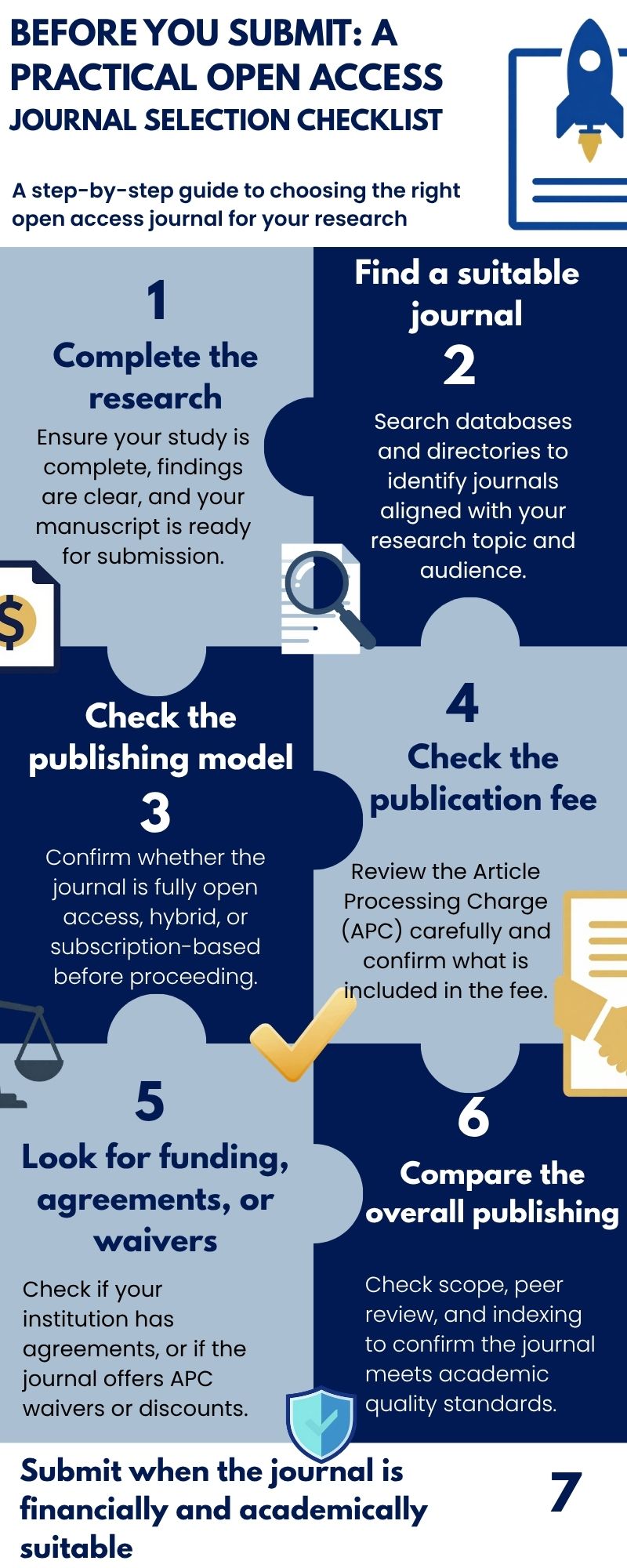
This is why journal selection should not begin and end with the words "Open Access."
A journal can be openly accessible to readers while still being financially difficult for authors.
Hidden cost is bigger than the invoice
Most obvious cost is the amount displayed on a publisher's website.
Deeper cost is what happens when two equally capable researchers have very different financial resources.
Imagine two academics have completed strong studies.
Researcher A has institutional funding that covers publication costs.
Researcher B has no dedicated publication budget.
Both have similar research quality. But their publication options may not be the same.
Researcher B may have to:
- search for a waiver;
- wait for additional funding;
- choose another journal;
- consider a different publishing route; or
- use personal or limited research funds.
This can affect more than convenience.
Publication opportunities may impact how soon the research is made available to people and how wide its reach would be. For researchers who have a limited budget for their research work, expensive publications may limit their choices and make it harder to share their work openly.
However, APCs are not the only factor leading to inequities.
Grant support, institutional status, language, network relations, government policy on research in various countries, journal prestige, and research infrastructure may all influence a paper's prospects of being published.
The issue is narrower, in that APCs represent but one quantifiable component of a far larger problem of inequity.
What does the research tell us?
The Argentina–Colombia study gives the discussion a useful financial dimension.
Argentina recorded 14,703 articles with APC payments, representing more than USD 31 million between 2013 and 2020. Colombia recorded 7,519 articles with APC payments, representing nearly USD 12 million during the same period.
The study also identified the publishing groups and journals receiving the highest APC payments from researchers in the two countries. This makes the research useful for understanding not just the existence of publication charges for journals, but their cumulative scale.
The wider international evidence points in a similar direction. Klebel and Ross-Hellauer found that institutional and national economic differences are connected with participation in APC-funded publishing.
The message is therefore more nuanced than "Open Access is expensive."
A better conclusion is:
Why waivers matter
An APC waiver can make a significant difference for researchers who cannot afford the standard article publishing charge.
However, waivers are not automatic.
The criteria for eligibility of the author for waiver in a journal could be determined by their country, institution, funding status, among others. Waivers can be full or partial.
Researchers should therefore check the actual policy before submission.
They should also look beyond the headline price.
| What to check | Why it matters |
|---|---|
| Journal scope | A cheaper journal is not useful if it does not fit the research. |
| journal publication fees | Check the complete fee structure before submission. |
| open access journal fees | Confirm whether your article type carries a charge. |
| open access journal cost | Compare the total expected cost, not just the advertised starting price. |
| open access publishing fees | Check whether additional charges apply. |
| Waiver policy | Confirm eligibility and application deadlines. |
| Indexing | Verify indexing through the relevant database. |
| Peer review | Look for a clear and transparent editorial process. |
The open access publication cost should therefore be considered alongside journal quality, relevance, transparency, indexing, and available funding.
What about an open access APC?
Researchers should understand that an open access APC is not necessarily the same across journals.
The amount may vary by publisher, journal, discipline, article type, and country. Some journals may also have institutional agreements or waiver programmes that change what an individual researcher actually pays.
That is why authors should never assume that the first price they see is their final cost.
Before submission, check:
- The current official publication charge.
- Whether taxes or additional fees apply.
- Whether your institution has a publishing agreement.
- Whether you qualify for a waiver.
- When a waiver application must be submitted.
- Whether the waiver covers the complete charge.
A few minutes of checking can prevent an unexpected financial problem after acceptance.
What should researchers do before paying?
The article processing charges should not be the only factor in choosing a journal, but they should never be ignored.
Before submission, researchers should ask:
- Does the journal genuinely fit my research?
- What is the complete publication charge?
- Is a waiver or discount available?
- Does my university have an agreement with the publisher?
- Is the journal properly indexed?
- Is the peer-review process clearly explained?
- Are there additional charges?
- Is the licensing information transparent?
- Does the publisher provide clear information about ownership and copyright?
The goal is not simply to find the cheapest journal.
It is to find a credible journal whose publishing model is academically appropriate and financially realistic.
That distinction is especially important because an unusually low fee should not automatically be treated as a sign of quality, just as a high fee does not automatically prove that a journal is prestigious.
Is Open Access still worth it?
Yes.
Open Access will help in making the research accessible and visible. It will be helpful for the students, researchers, universities, professionals, policymakers, and general public who do not have access to expensive subscriptions databases.
The problem is not Open Access itself.
This becomes an issue because the financial burden for the accomplishment of this access rests unequally on researchers who lack more resources.
The data provided by Argentina and Colombia illustrates the fact that there have been heavy expenditures for APC publication. However, it does not demonstrate that all researchers in Latin America are being left out.
This differentiation is crucial for a reasonable debate.
The better question is:
This will be partially determined by how journals, universities, funding bodies, publishers, and the research systems in each country react to such a shift.
Transparent pricing will help.
Better waiver programs will help.
Agreements between institutions and publishers will help.
Special funding for non-funded researchers will help.
Support for policy and institutional support can help make Open Access more equitable through affordability, transparency, training, and help for younger and non-funded researchers.
Conclusion: Open for readers, fair for researchers
The idea of Open Access is straightforward: research should be accessible to those who need it.
However, accessibility has two components.
The readers require accessible pricing for scholarly articles.
And the researchers require accessible venues for publishing their work.
Examples from Argentina and Colombia make it clear why this classification should be considered. The expenditure on APC for recorded transactions by research institutes and scholars in these countries was over 43 million US dollars between 2013 and 2020, but the reality is that economics can influence APC-funded Open Access utilization.
For Latin American scholars, the message here is very simple.
Do not select a journal only because it claims to be Open Access.
Check the fee. Check the waiver. Check the scope of the journal. Check indexing. Check its peer-review process. Check its licensing. Check if institutional support is available.
Above all else, check the whole publication model.
A fair scholarly system should not make the visibility of good research depend primarily on whether its author can afford the publication bill.
Open Access should not mean only "free for the reader."
The longer-term goal should be "accessible to readers and fair to researchers."
FAQs
1. Are APCs mandatory for every Open Access journal?
Not all. Some Open Access journals do not have any author fees and are funded by universities, societies, grants, institutions, or other sources.
2. How can Latin American researchers reduce the cost of Open Access publishing?
Authors may compare journals, find out about institutional agreements, request waiver, or look into reputable no-fee journals.
3. Do APC waivers guarantee completely free publication?
Not all. Requirements for waiver vary between journals and countries, so authors should verify them prior to manuscript submission.
4. Are expensive Open Access journals always better?
No. Price does not prove quality. Researchers should assess scope, peer review, indexing, transparency, reputation, licensing, and relevance before making decisions.
5. What should researchers check before paying publication charges?
Verify the official fee, waiver policy, indexing, peer-review process, licensing terms, publisher, article type, taxes, and any additional charges before submitting.