

“Your research may be ready. But are you and your manuscript ready for the correct journal?”
Data has been gathered. Analysis has been done. The paper is written. What comes next can be the least certain part of the entire process: figuring out where — and how — to publish.
Is it necessary to aim for Q1, or will Q2 do just fine? How does one ascertain that the journal in question is indeed Scopus indexed? What is the process that follows submission of the manuscript?
Publishing in a Scopus indexed journal publication does not mean just submitting to a journal and sending the article for publication. It means a process of decision making that ranges from writing the manuscript to checking its indexing status.
Now, let's dig deep into what it really takes to get published in a Scopus-Indexed Journal actually….
1. What Is Scopus Indexed Journals?
Scopus is a database of abstracts and citations that includes literature from many fields. The titles of journals are not included automatically but are evaluated through a process regulated by the Scopus Content Selection and Advisory Board.
If a journal is said to be Scopus indexed journal publication, then the journal is actually included in the Scopus database. However, being Scopus indexed does not imply acceptance of all the manuscripts submitted to it.
The journal is evaluated by Scopus. The journal's editors and reviewers evaluate the paper. These are two different things, and confusing between them is probably the most common misconception among young researchers.
Common Misconceptions
| Assumption | Clarification |
|---|---|
| Scopus indexing guarantees acceptance | Editorial and peer-review decisions remain independent |
| Scopus indexing guarantees article quality | Quality is assessed article by article |
| Scopus indexing guarantees citations | Citation counts depend on impact and visibility, not indexing status |
| Scopus indexing removes the need to assess fit | Scope, audience, and methodology alignment still require separate evaluation |
Scopus indexing should be considered as one of the many factors for journal selection. Other factors to consider include:
- Scope of journal and subject matching
- Publication history of the journal
- Composition of the editorial board
- Peer review process
- Metrics of the journal (CiteScore, SJR, SNIP)
- Publication frequency
- Article Processing Charges (APCs)
- Publication ethics
- Present indexing of the journal (instead of historical indexing)
Reference Glossary
| Term | Definition |
|---|---|
| Scopus | An abstract and citation database covering scholarly literature |
| CiteScore | A Scopus metric reflecting average citations per document |
| SJR (SCImago Journal Rank) | A metric reflecting journal prestige, weighted by source |
| SNIP | A field-normalised metric comparing citation impact across disciplines |
| Q1–Q4 | Quartile rankings of a journal within its subject category |
| Impact Factor | A separate metric from Journal Citation Reports / Web of Science, not Scopus |
| DOI | A persistent identifier assigned to a published digital work |
Another source of misunderstanding is with credentials that are often incorrectly associated with indexing:
- Having an ISSN alone is not enough to prove Scopus indexing.
- Having a DOI alone is not enough to prove Scopus indexing.
- Having a professional website alone is not enough to prove Scopus indexing.
2. The Seven Decisions That Shape the Publication Journey
Publishing is frequently considered to be one big decision – "what journal should I use?" The process is actually made up of at least seven different decisions, as indicated below.
.jpg.jpeg)
Figure 1. The seven decisions in the publication journey
2.1 Manuscript Readiness
A finished manuscript does not always mean a ready-for-submission one. Before submission, remember that:
- Is the research question clear?
- Is the research gap evident?
- Is the research methodology suitable for the research question?
- Are the findings explained clearly?
- Is the research contribution identified?
- Are the references reliable and relevant?
- Are the ethics statements provided?
- Has the manuscript followed the target journal’s format guidelines?
The critical point is that if the editor looks at the title, abstract, and introduction only, will they be able to understand why the research matters? If not, further revision is advisable before submission.
2.1 Manuscript Readiness
A finished manuscript does not always mean a ready-for-submission one. Before submission, remember that:
- Is the research question clear?
- Is the research gap evident?
- Is the research methodology suitable for the research question?
- Are the findings explained clearly?
- Is the research contribution identified?
- Are the references reliable and relevant?
- Are the ethics statements provided?
- Has the manuscript followed the target journal’s format guidelines?
The critical point is that if the editor looks at the title, abstract, and introduction only, will they be able to understand why the research matters? If not, further revision is advisable before submission.
2.2 Journal Fit
Just because a journal is listed in the scopus indexed journals list does not mean that the journal will be suitable for publishing a particular manuscript.
The issue here is whether the journal has ever published research of this sort — considering aims and scope, subject area, article types accepted, recent publications, and typical methodologies.
2.3 Indexing Verification
Never take a "Scopus Indexed" banner on a journal’s web page at face value. It is best to conduct the verification process independently – the details of this are discussed in Section 4.
2.4 Submission Readiness
Before submitting, check your formatting, references, cover letter, declarations, figures, tables, and other supporting documents.
Submittal mistakes that could easily have been avoided often cause undue delays.
2.5 Editorial Screening
There are many cases in which manuscripts never go to the outside reviewer since there is desk rejection, which means that the editors might reject the manuscript even before the process of peer review starts.
This is elaborated on in Section 5.
2.6 Peer Review
Reviewers generally look into originality, the research question, methodology, data and analysis, interaction with literature, discussion, contribution, and limitations.
2.7 Revision and Acceptance
A request for revision is not a rejection. Instead, it is a chance to solve problems before the final decision is made.
3. Journal Selection Is a Matching Problem, Not a Scopus Journal Ranking Problem
Here is a mistake many researchers make.
They search for:
“Best Q1 Scopus journals.”
But a better question is:
“Which suitable journal is the best match for my research?”
Even if a journal is highly ranked within a discipline, it does not necessarily mean that the journal is the best place to publish a particular paper.
A top-ranking general journal that never publishes papers on a certain sub-discipline might be a less suitable option than a less ranked journal.
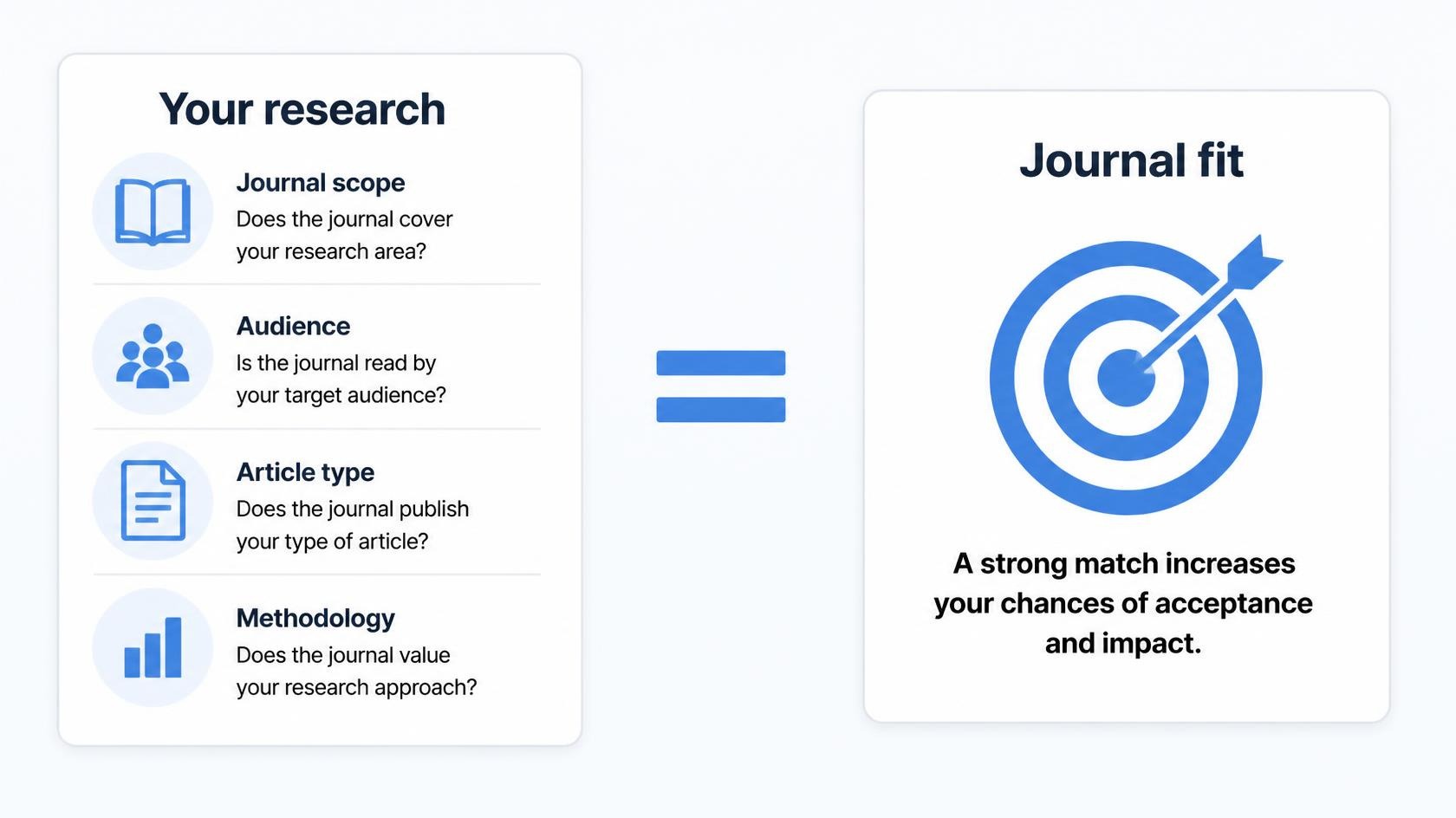
Figure 2. The journal-fit formula
Journal Fit Scorecard
After making a decision, each candidate journal can be graded on the following basis (0–10 for each criterion):
| Factor | Score |
|---|---|
| Scope match | /10 |
| Similarity to recently published articles | /10 |
| Alignment with target readership | /10 |
| Methodology fit | /10 |
| Article type accepted | /10 |
| Editorial transparency | /10 |
| Current indexing status | /10 |
| Publication frequency | /10 |
| Journal metrics | /10 |
| APC / value | /10 |
The purpose of the exercise is not to simply opt for the highest possible sum of the scores, but to use the decision-making process based on evidence, rather than only prestige.
The Rule of Thumb
The journal must be selected due to the fact that the research belongs there, and not because of its rank.
A useful rule:
It is very important that one should not select a journal just because its Scopus journal rank appears to be good. It should be selected only because the research is supposed to fit into it.
4. How to Check Scopus Indexed Journals
Current Scopus Coverage
This is probably one of the most important parts of the publishing process, since journal sites can contain outdated information about their presence on databases.
For example, some journals was indexed in Scopus before, but continue to show that even after losing this status.
Scopus offers a Sources Search tool, where the up-to-date list of sources can be found.
What Should Be Checked
| Verification Point | What to Confirm |
|---|---|
| Journal title | Exact match to the official record |
| ISSN / E-ISSN | Matches the journal precisely |
| Publisher | Same publisher as the official listing |
| Subject area | Relevant discipline classification |
| Coverage | Years currently covered |
| Status | Active versus discontinued |
| Metrics | Currently available metrics (CiteScore, SJR, SNIP) |
Terminology That Is Frequently Confused
The following phrases are not interchangeable, and appear regularly on journal websites:
- “Scopus indexed”
- “Scopus submitted”
- “Scopus under evaluation”
- “Scopus applied”
"Applied for indexing" does not equate to "indexed."
"Previously indexed" does not automatically mean "currently indexed."
A listing on an external website is no validation at all.
Discontinued coverage is another characteristic of sources detected by Scopus. Thus, another important feature that needs verification is the present status of the source.
5. What Editors Look for Before a Paper Reaches Peer Review
Once the paper has been submitted, it goes through an initial screening by the editors before sending it to any reviewers.
.jpg.jpeg) Figure 3. Editorial screening: what happens before peer review
Figure 3. Editorial screening: what happens before peer review
At this stage, an editor is typically assessing:
- Does the manuscript match the focus of the journal?
- Is the manuscript subject matter relevant to the journal’s audience?
- Does the research seem original enough?
- Is the submission comprehensive?
- Is the methodology acceptable?
- Does the manuscript adhere to the journal's format?
Common Reasons for Desk Rejection
| Problem | Editorial Interpretation |
|---|---|
| Wrong scope | The manuscript belongs in a different journal |
| Weak novelty | The contribution is not clearly established |
| Poor abstract | The value of the study is not evident |
| Weak presentation | The manuscript requires substantial revision before it can be assessed |
| Formatting problems | Scopus journal requirements have not been followed |
| Methodological concerns | The study may not meet the journal's standards |
| Incomplete submission | Required information or files are missing |
Here is an example showing how submission preparation and suitability of the journal are linked — a good paper sent to the wrong journal may get rejected here.
6. What Makes a Manuscript Competitive?
While there is no formula for acceptance, competitive essays will always make clear the significance of the contribution.
A reader should always be able to see:
- The problem — what issue does the study address?
- The gap — what is missing from the existing literature?
- The method — what approach was used?
- The evidence — what were the key findings?
- The contribution — why does this research matter?
A useful shorthand is:
Problem → Gap → Method → Evidence → Contribution
If any one of these elements is weak, the overall argument tends to read as incomplete.
A competitive manuscript should also demonstrate:
- A clearly defined research question
- An arguable and well-explained methodology
- Results that back up the claims made
- Literature that relates to the topic and is not there just to add citations
- Discussion that interprets the results and does not repeat them
- A clear statement of contributions
- Presentation (charts, graphs, and words) that helps to make the point
7. A Good Manuscript Can Still Be Rejected
This is a very difficult yet crucial lesson for young researchers to learn: Rejection does not necessarily imply bad research.
There are reasons why a paper may have been rejected, such as inappropriate journal choice, changed priorities among the editorial board, or methodological issues raised by the reviewers.
Desk Rejection Versus Peer-Review Rejection
| Desk Rejection | Peer-Review Rejection |
|---|---|
| Occurs before external review | Occurs after reviewer assessment |
| Typically concerns scope, fit, or format | Typically concerns methodology, evidence, or originality |
| Decided by the editor or editorial team | Informed by reviewer feedback and editorial judgment |
Recommended Response to Rejection
.jpg.jpeg)
Figure 4. Responding to a rejection
The unrevised manuscript should not be simply submitted elsewhere. The feedback of rejection, when properly utilized, is a legitimate input into the next submission.
8. What Happens After Submission
The publication process continues well beyond the point of submission.
.jpg.jpeg)
Figure 5. The full Scopus paper publication process
Tracking systems in general will show status updates like the following:
"Submitted" → "With Editor" → "Under Review" → "Required Reviews Completed" → "Revision Requested" → "Accepted" → "In Production"
Different journals and submission systems use different terminologies, and an update of the status doesn’t necessarily mean any problem at all.
9. How to Respond to Reviewer Comments and Revisions
The major revision request is often wrongly perceived by an author as a rejection, when in reality, the editorial board is seeking clarification on certain matters before making its final decision.
Reviewer-Response Table (Illustrative Example)
| Reviewer Comment | Author Response | Manuscript Change |
|---|---|---|
| Explain the methodology further | Additional methodological detail provided | Methodology section expanded |
| Add recent literature | Relevant recent studies incorporated | Literature review updated |
| Clarify the conclusion | Conclusion narrowed and sharpened | Conclusion revised |
A well-constructed response should:
- Address each and every point that has been raised.
- Describe what was changed.
- Show exactly where the change was made.
- Give your reasons for rejecting any suggestion.
- Maintain a professional attitude at all times.
It is fine to disagree with a reviewer, but disagreement must not take the form of dismissiveness.
The purpose is not to beat the reviewer at an argument but to show that the issue has been taken into account.
10. How Long Does the Process Take?
There is no one definitive time frame for the Scopus publication process. This whole process relies on different phases which may vary separately from one another.
| Stage | Principal Influencing Factor |
|---|---|
| Manuscript preparation | Author workload |
| Editorial screening | Journal workload |
| Reviewer selection | Reviewer availability |
| Peer review | Reviewer response time and manuscript complexity |
| Revision | Speed of author response |
| Final decision | Editorial assessment |
| Production | Publisher workflow |
| Indexing | Database processing time |
It is also important to understand that there is a difference between publication and indexing.
An article might get accepted first, then be published, but still not indexed due to various reasons.
There is another example of such status in Scopus, namely “Articles in Press,” referring to those articles that have been accepted but have not yet been allocated to the issue of the journal.
Claims of fast publication should be examined closely since just because it is fast doesn’t necessarily mean that there is acceptance or peer review.
10. How Long Does the Process Take?
There is no single, reliable figure for the duration of the Scopus publication process. The overall timeline depends on several distinct stages, each of which can vary independently.
| Stage | Principal Influencing Factor |
|---|---|
| Manuscript preparation | Author workload |
| Editorial screening | Journal workload |
| Reviewer selection | Reviewer availability |
| Peer review | Reviewer response time and manuscript complexity |
| Revision | Speed of author response |
| Final decision | Editorial assessment |
| Production | Publisher workflow |
| Indexing | Database processing time |
It is also worth noting that publication and indexing are distinct events: a paper may be accepted, then published, and only subsequently processed for database coverage.
Scopus supports an Articles in Press status for accepted papers not yet assigned to a journal issue, which further illustrates why acceptance, publication, and indexing should not be treated as a single milestone.
Claims of guaranteed rapid publication warrant scrutiny: a fast timeline does not, on its own, guarantee acceptance, peer review, or Scopus indexing.
11. Understanding Article Processing Charges (APCs)
APC means Article Processing Charge.
APC is not required by all journals; there are different models of publishing, subscription-based, for example.
However, before the APC is paid, it would be wise to verify:
- Is the fee transparently communicated?
- At which point is it levied?
- Is payment compulsory for publication?
- Are there any waiver or discount provisions?
- Does there exist any other fee apart from the announced APC?
- What exactly is covered by the fee?
The fee amount is not a measure of journal quality: a low APC fee is not necessarily indicative of a poor journal, nor is a high APC fee indicative of a good journal.
12. UK Researchers: What Should You Check Before Choosing a Journal?
The requirements of institutions and funders for UK academic journals are not uniform.
When choosing an academic journal, researchers must verify:
Institutional requirements – when the department sets out conditions regarding journal quality, indexing, and subject matter.
Funder requirements – when research is sponsored by an organization which sets out conditions regarding open access, repository deposition, licensing, or publication timeline.
Publication charges – whether the institute has an agreement with the journal, the availability of APC funding, and whether there are any waivers for such costs.
Documentation: keeping journal particulars, verification of indexing status, proof of submission, acceptance letter, and any receipt for any APCs.
It is important to mention that Scopus indexing alone does not ensure adherence to the publication policies of particular universities or funding agencies.
It is always advisable to check institutional policies.
13. What Legitimate Publication Support Should Involve
Some researchers manage the full process independently; others benefit from support at particular stages.
A legitimate publication-support service should help researchers navigate the process rather than promise to control its outcome of research paper publication.
Riset provides Scopus publication guidelines and support across several stages of the publishing journey, including:
Manuscript Development
Strengthening structure, clarity, style, and readability from an initial draft through to submission.
Journal Selection Strategy
Analysing a manuscript and identifying candidate journals based on scope, impact metrics, and acceptance considerations.
Pre-Submission Peer Review
A simulated review intended to surface the kinds of concerns an editor or reviewer might raise before formal submission.
Submission-Ready Packaging
Formatting, cover letter preparation, and supplementary documentation, so that avoidable submission errors do not delay otherwise sound research.
Portal Submission and Tracking
Support with Scopus journal submission systems and status tracking.
Reviewer-Response Support
Assistance interpreting reviewer comments and preparing structured, professional responses, including point-by-point response letters.
Post-Acceptance Support
Galley proof review, copyright-form guidance, and final publication steps.
Additional Scholarly Outputs
| Output Type | Support Includes |
|---|---|
| Conference proceedings | Editing, formatting, and submission against conference requirements |
| Book chapters | Structuring, editing, and submission guidance |
| OJS (Open Journal Systems) | Journal setup, workflow management, platform customisation, editor and reviewer training |
The relationship between author-facing support and journal-facing (OJS) support can be summarised as follows:
What Legitimate Scopus Publication Support Should Include
The following claims should be treated as warning signs when evaluating a publication-support provider:
- Guaranteed acceptance
- Guaranteed Scopus indexing
- Guaranteed Q1 publication
- Guaranteed positive peer review
- Publication within an unrealistically short timeframe
These outcomes are determined independently by editors, reviewers, journals, and indexing databases — no service provider controls them directly.
Riset's own terms explicitly state that it does not guarantee journal acceptance, peer-review outcomes, or indexing in databases such as Scopus or Web of Science.
Legitimate support offers a process. It does not offer a guaranteed outcome.
Evaluation Checklist for a Support Provider
| Question | Relevance |
|---|---|
| Does the service help improve the manuscript? | Strengthens presentation and clarity |
| Does it evaluate journal fit? | Reduces the risk of a poor journal match |
| Does it verify journal indexing status? | Avoids reliance on outdated claims |
| Does it offer pre-submission review? | Surfaces weaknesses before formal review |
| Does it assist with formatting? | Reduces avoidable technical errors |
| Does it support reviewer responses? | Aids the revision process |
| Does it offer post-acceptance support? | Covers later production stages |
| Are fees stated transparently? | Enables informed cost assessment |
| Does it guarantee acceptance? | Warning sign |
| Does it guarantee indexing? | Warning sign |
14. Pre-Submission Checklist
Manuscript
- Research question clearly defined
- Research gap clearly outlined
- Contribution to knowledge clearly articulated
- Methodology fit for purpose
- Results clearly described
- Discussion interprets the findings, not simply repeats them
- References cited appropriately and accurately
- Ethical declarations complete
- Language and presentation verified
Journal
- Research scope is consistent with the manuscript
- Recently published papers are pertinent to the manuscript’s topic
- Scopus indexing is independently confirmed
- ISSN is verified with the official record
- Publisher information has been confirmed
- Peer review process is clearly stated
- APC and publishing model understood
Submission
- Followed the author guidelines
- Maintained the required word limit
- Made the figures and tables in accordance with journal requirements
- Formatted the references properly
- Prepared cover letter
- Filled the declarations
- Uploaded supplementary files
- Verified author details
Frequently Asked Questions
How can I verify if a journal is currently indexed in Scopus?
Scopus Sources must be searched with the name and ISSN of the journal. Verify the publisher, the field of study, years of coverage, and current status of the journal in indexing.
Can a Scopus-indexed journal reject my research paper?
Yes. Being indexed by Scopus doesn’t mean that an article will definitely get accepted. It could be rejected for various reasons including poor fit, lack of originality, methodological issues, and presentation problems.
What publication support services does Riset provide?
The Riset services include manuscript development, journal selection, pre-submission consultation, formatting, submission help, response to reviewers, post-acceptance help, conference papers, book chapters, and OJS services.
Can Riset guarantee publication in a Scopus-indexed journal?
No. Riset does not ensure acceptance or indexing. Its purpose is to offer professional assistance in publication while leaving all final decisions with the journal itself.
How long does Scopus journal publication take?
There is no fixed time frame. Publication is dependent on editorial screening, reviewer availability, and decisions among other considerations by the journal.
Conclusion
A Scopus indexed journal publication is the result of a structured sequence of decisions rather than a single action: manuscript preparation, journal selection, indexing verification, submission, editorial screening, peer review, revision, and — where the process concludes successfully — acceptance and publication.
The more productive framing is not “I need to publish in Scopus,” but rather “I need to publish this research in the right journal, through a legitimate and transparent process.”
That shift in framing helps researchers avoid several of the most common and avoidable mistakes in academic publishing.
Riset helps through various stages in this process, which include writing help, journal selection, pre-submission review, submission assistance, tracking submission, reviewer response support, and post-acceptance help, apart from more general help with conference proceedings, book chapters, and OJS for scholarly journals.
The research remains the author's own. The academic decisions remain the author's own. The final editorial decision belongs to the journal.
Legitimate support does not bypass that process — it helps researchers navigate it more effectively.